
AICROS

Full-Service CRO vs. Functional Service Provider: Which Model Fits Your Trial?


A practical decision framework for sponsors weighing turnkey trial delivery against function-by-function outsourcing — and what ICH E6(R3) now expects under both.

Almost every drug developer outsources some part of clinical development. The harder question is how. Do you hand a single contract research organization (CRO) end-to-end responsibility for a study, or contract specialist teams to run discrete functions — monitoring, data management, biostatistics, pharmacovigilance — inside your own processes? The answer shapes your cost structure, your control over data and timelines and, increasingly, how you will demonstrate sponsor oversight to inspectors.

This guide compares full-service outsourcing (FSO) with the functional service provider (FSP) model, summarizes what industry data says about each, and lays out six questions to decide which model fits your trial — or whether a hybrid fits better. It also looks at an option that is easy to overlook when the debate is framed around the largest global CROs: an international alliance of independent, specialist CROs.

Two Models, Defined

Full-service outsourcing. In a full-service engagement, a CRO takes trial-level responsibility for delivering a study — typically protocol support, site selection and activation, monitoring, data management, biostatistics, medical writing, safety reporting and regulatory submissions — under its own SOPs, systems and project management. The sponsor buys an outcome (a delivered study) against a contracted budget and manages the CRO through governance meetings, KPIs and change orders.

Functional service provider. In an FSP engagement, the sponsor outsources all or part of a single function — for example, clinical monitoring across a portfolio, or SDTM and ADaM programming for every study in a therapeutic area. FSP teams usually work within the sponsor’s SOPs, systems and quality management system (QMS), and are commonly priced on a full-time-equivalent (FTE) or unit basis. The sponsor keeps study-level leadership and buys capacity and expertise rather than a delivered study.

The distinction is not simply who performs the work, but how responsibility, process ownership and operational control are allocated. Full-service engagements generally rely more heavily on the CRO’s systems and procedures, while FSP teams are more commonly embedded within the sponsor’s operating environment. The precise allocation should always be documented in the contract.

A Third Route: Alliances of Independent Specialist CROs

Discussions of full service versus FSP usually assume a single large global CRO on the other side of the table. There is another option. An international alliance of independent, specialist CROs can combine multinational reach with the strengths of smaller providers: in-country teams that know local regulators, ethics committees, and site networks first-hand, plus direct access to the senior experts who design and deliver the work.

Because alliance members are specialists, they can sit on either side of the model divide. A biostatistics or pharmacovigilance group can work as an FSP inside a sponsor’s systems, take full-service responsibility for a defined scope, or anchor one function within a hybrid program, while partner organizations in other countries provide local clinical operations and regulatory support. As with any multi-provider arrangement, the model works best when one party coordinates delivery and responsibilities are documented in the contract.

What the Market Data Shows

FSP has moved from a large-pharma niche to a mainstream model. Astute Analytica valued the global FSP market at US$17.9 billion in 2024 and projects US$38.56 billion by 2033, a compound annual growth rate of 8.9%.[1] Published estimates vary by methodology, but the direction is consistent.

Most sponsors now use more than one model. In PPD’s 2026 Pulse Survey of 150 senior biopharma and biotech leaders, respondents reported that full service accounts for about one-third of their current clinical development work, with FSP and hybrid models each accounting for about one-quarter. [2] Company size still shapes the mix: Avoca Group’s industry research found that smaller sponsors (annual sales under US$2 billion) allocated more of their outsourced clinical spend to full-service providers than the top-50 biopharmas did. [3]

Popularity is not the same as fit. A pilot study published in Applied Clinical Trials found that trials relying primarily on full service tended to be among the longest and most complex in the sample. [4]. Experienced sponsors match the model to the study, not the other way round.

The Regulatory Baseline: Delegation Without Abdication

Neither model changes who is ultimately accountable. Under 21 CFR 312.52, a sponsor may transfer any or all of its IND obligations to a CRO, but the transfer must be described in writing; any obligation not covered is deemed not transferred, and a CRO that assumes obligations becomes subject to the same regulatory action as a sponsor. [5] In the EU, Article 71 of the Clinical Trials Regulation (CTR) allows a sponsor to delegate tasks by written contract, but that delegation is without prejudice to the sponsor’s responsibility for subject safety and the reliability of trial data. [6]

ICH E6(R3), finalized in January 2025, raises the bar on how that accountability is demonstrated. It builds a structured, risk-proportionate sponsor oversight framework that applies to every service provider—full-service CROs and FSPs alike—including documented provider qualification, clear allocation of transferred activities, and oversight of subcontracted work. [7] ICH E6(R3) became applicable in the EU on 23 July 2025, and FDA issued it as final guidance for industry in September 2025. As FDA guidance, it contains non-binding recommendations rather than establishing a separate mandatory compliance date. [8]

The practical implication differs by model. Under full service, oversight centers on qualifying the CRO’s quality system and verifying its outputs. Under FSP, the sponsor’s own QMS is the system under inspection, so its SOPs, training records and Trial Master File (TMF) must fully cover the embedded team’s work. In both cases, passive oversight — accepting status reports without challenge — is no longer defensible.

Table 1. Full-service CRO vs. FSP at a glance

Dimension Full-service CRO Functional service provider
Scope End-to-end delivery of a study One or more functions across studies or a portfolio
Process ownership CRO SOPs, systems and QMS Sponsor SOPs, systems and QMS
Project leadership CRO project manager Sponsor study team
Pricing Unit or milestone budget, plus change orders FTE- or unit-based resourcing
Sponsor infrastructure Lean — governance and oversight roles Substantial — validated systems, SOPs, functional leads
Data control Contractual; access via CRO systems Direct; data stays in the sponsor environment
Scalability Study by study Flexible across the portfolio
E6(R3) oversight focus Qualify and monitor CRO QMS and deliverables Own QMS, training and TMF; must cover embedded staff
Typical fit Small or virtual biotech; complex single assets; rescue studies Mid-size to large sponsors with steady multi-study pipelines

Six Questions That Decide the Model

1. Do you have the infrastructure to host an FSP?

An FSP assumes the sponsor has validated systems (EDC, CTMS, eTMF, safety database), GCP-compliant SOPs and functional leaders to direct the work. A virtual biotech with a small team rarely does, and building that infrastructure for a single study is seldom economical — one reason smaller sponsors lean toward full service.

2. Is this a single study or a sustained portfolio?

FSP economics depend on continuity: a stable team carrying standards, templates and therapeutic-area knowledge from study to study. A one-off Phase I or Phase II study rarely justifies building FSP arrangements across every function, but it can still make sense to place specialist functions — biostatistics, statistical programming, medical writing or pharmacovigilance — with an FSP, particularly where that expertise is hard to source in-house and will carry forward into later phases.

3. How complex and multinational is the trial?

Large, multi-country studies with many sites, country-specific submissions, and local-language requirements reward providers with integrated project management and regional reach. Sponsors not established in the EU generally require an EU-based legal representative under Article 74 of the CTR, although specified Member State exceptions may permit an EU contact person instead. [6]. That reach does not have to come from a single global provider: an alliance of independent CROs with in-country members can supply local regulatory and operational knowledge across jurisdictions.

4. Who needs to own data standards and the analysis environment?

If you plan integrated analyses across studies, consistent CDISC SDTM and ADaM implementation across the program matters. FSP biostatistics and programming teams working inside the sponsor’s metadata and statistical analysis plan (SAP) templates make pooling easier; under full service, specify standards and deliverable formats contractually.

5. How predictable is your scope — and your budget tolerance?

Full-service models consolidate delivery into a study-level budget, but uncertainty in design, enrolment or timelines may still result in assumptions, contingencies and change orders. FSP models can provide a more visible resourcing run-rate, while leaving the sponsor with greater responsibility for workload and delivery risk.

6. Where is your oversight capacity strongest?

Under E6(R3), oversight must be evidenced either way. Sponsors with deep functional expertise often find it easier to oversee an FSP inside their own processes; sponsors with lean teams may be better served by a full-service CRO with a mature QMS and a robust, documented oversight plan.

Table 2. Model fit by sponsor scenario

Scenario Often fits Why
Virtual biotech, first-in-human or Phase I/II asset Full service No internal systems or SOPs; needs turnkey delivery and regulatory support. Specialist functions such as biostatistics, programming, medical writing or pharmacovigilance may still suit an FSP
Emerging biotech, first multinational Phase III Full service or hybrid Complexity and country reach favor FSO; biostatistics or medical writing can sit with an FSP for program continuity
Mid-size sponsor with internal clinical operations FSP or hybrid Infrastructure exists; FSP adds capacity in monitoring, data management or programming
Large pharma portfolio FSP-led, selective FSO Standardization and cost predictability at scale; FSO for capacity peaks or niche indications
Rescue or takeover study Full service (specialist) Needs rapid, accountable remediation under the provider’s own processes
Post-marketing safety obligations FSP or specialist managed service (pharmacovigilance) Continuous, process-driven work; the choice depends on how much of the safety system, including QPPV and PSMF continuity under GVP, the sponsor retains in-house


Hybrid Models: The Common Middle Ground

Many sponsors no longer choose one model outright. A typical hybrid places trial-level delivery with a full-service CRO while retaining one or two functions — often biostatistics, pharmacovigilance or medical writing — with an FSP or in-house team that serves the whole program. Hybrids preserve program-level consistency where it matters most without the infrastructure burden of insourcing everything.

The trade-off is interface risk. Each handoff — for example, between a CRO’s data management team and an FSP’s SDTM programmers — needs a defined data transfer specification, timelines and an escalation path. Hybrids work when you map responsibilities in a single RACI and reflect them in each provider’s written transfer of obligations.

Contracting for Oversight Under Either Model

Whichever model you choose, build these elements into the agreement:

  • A written transfer of regulatory obligations (TORO) itemizing each transferred duty, aligned with 21 CFR 312.52 and CTR Article 71.
  • A quality agreement covering SOP hierarchy, deviation handling, CAPA and audit rights — including flow-down to subcontractors.
  • Defined ownership, access and retention of essential records and the TMF, consistent with ALCOA+ data integrity principles.
  • Risk-based KPIs and quality tolerance limits tied to critical-to-quality factors, reviewed in documented governance meetings.
  • Training requirements for provider staff on the protocol, GCP and sponsor-specific processes.

Frequently Asked Questions

Is an FSP cheaper than a full-service CRO?

Not inherently. FSP models often lower unit costs and improve budget predictability for sponsors with steady workloads and existing infrastructure, but the sponsor absorbs the cost of systems, SOPs and project leadership that a full-service CRO bundles. Compare total cost of ownership, not rate cards.

Does using an FSP transfer regulatory obligations?

Only those transferred in writing. FSP staff often work under the sponsor’s processes without a formal transfer of IND obligations, leaving the sponsor directly responsible for that work. Make the allocation explicit in the contract.

Can a sponsor switch from full service to FSP mid-program?

Yes, and many do as their pipeline matures — usually function by function. Time transitions around study boundaries or database locks, and specify data, TMF and knowledge handover in the exit provisions.

Which functions are most often outsourced on an FSP basis?

Clinical monitoring, data management, biostatistics and statistical programming, pharmacovigilance, regulatory affairs and medical writing — process-driven functions where continuity and standardization pay off.

How does ICH E6(R3) affect the choice?

It does not favor either model, but it makes risk-proportionate oversight of every service provider explicit. Choose the model whose oversight you can realistically resource and evidence.

About AICROS

The Association of International CROs (AICROS) is a global alliance of small-to-midsize contract research organizations headquartered in Bremen, Germany. Member organizations deliver specialist-led services across biostatistics, clinical operations, data management, medical writing, pharmacovigilance and regulatory affairs, pairing the attentiveness of independent providers with multinational reach.

Weighing full-service, FSP or hybrid support for your next study? Contact the AICROS team at info@aicros.org to discuss which model fits your trial — and which specialist partners can deliver it.

References

  1. Astute Analytica. “Functional Service Provider (FSP) Market to Reach US$ 38.56 Billion by 2033.” GlobeNewswire, 8 September 2025. https://www.globenewswire.com/news-release/2025/09/08/3146294/0/en/Functional-Service-Provider-FSP-Market-to-Reach-US-38-56-Billion-by-2033-Astute-Analytica.html
  2. PPD, the clinical research business of Thermo Fisher Scientific. 2026 Pulse Survey of biopharma and biotech leaders (n = 150), summarized on the PPD blog, 11 May 2026. https://www.ppd.com/blog/drug-development-trends-2026/
  3. Avoca Group. “Industry Report on Outsourcing Spend, Models, and Measures.” Applied Clinical Trials, Vol. 28, Issue 10, October 2019. https://www.appliedclinicaltrialsonline.com/view/industry-report-outsourcing-spend-models-and-measures
  4. Applied Clinical Trials. “Outsourcing Model Usage and Its Relationship to Clinical Trial Performance.” https://appliedclinicaltrialsonline.com/view/outsourcing-model-usage-and-its-relationship-to-clinical-trial-performance
  5. U.S. Code of Federal Regulations. 21 CFR § 312.52 — Transfer of obligations to a contract research organization. https://www.law.cornell.edu/cfr/text/21/312.52
  6. Regulation (EU) No 536/2014 on clinical trials on medicinal products for human use, Articles 71 and 74. https://eur-lex.europa.eu/eli/reg/2014/536/oj
  7. International Council for Harmonisation. ICH E6(R3) Guideline for Good Clinical Practice (Principles and Annex 1), Step 4, 6 January 2025. https://www.ich.org/page/efficacy-guidelines
  8. Bieze, B. “FDA Publishes ICH E6(R3): What It Means for U.S. Clinical Trials.” Association of Clinical Research Professionals, 16 September 2025. https://acrpnet.org/2025/09/16/fda-publishes-ich-e6r3-what-it-means-for-u-s-clinical-trials
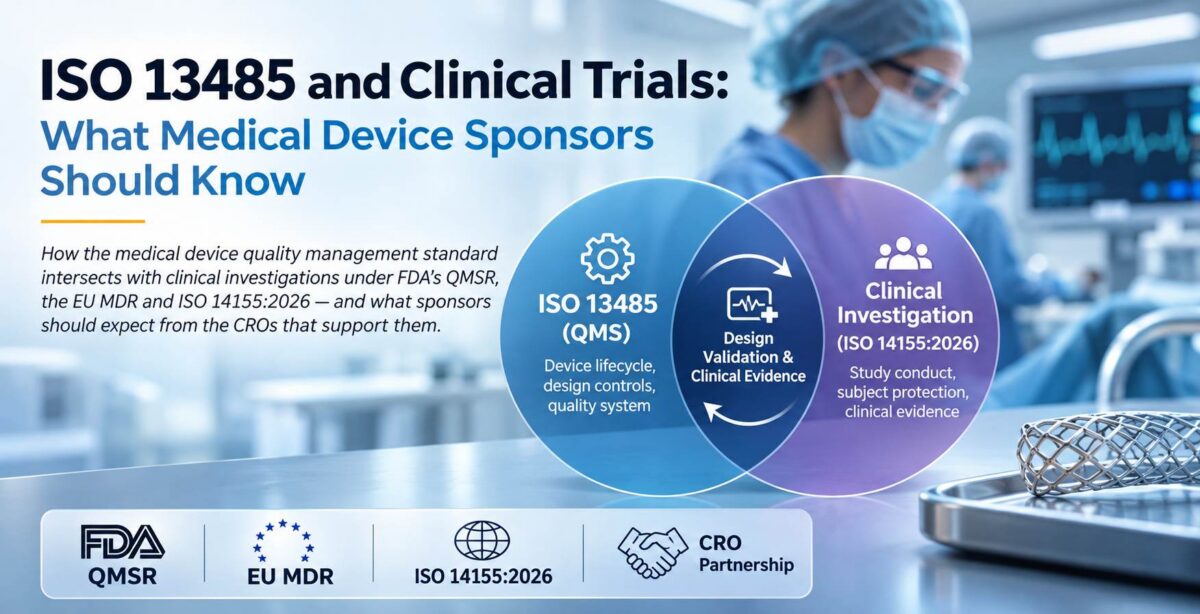
ISO 13485 and Clinical Trials: What Medical Device Sponsors Should Know

How the medical device quality management standard intersects with clinical investigations under FDA’s QMSR, the EU MDR and ISO 14155:2026 — and what sponsors should expect from the CROs that support them.

For most of its 30-year history, ISO 13485 has been treated as a manufacturing standard — something that governs production lines, supplier audits and complaint files, not clinical research. That view is now outdated. Since February 2, 2026, the U.S. Food and Drug Administration has enforced its Quality Management System Regulation (QMSR), which incorporates ISO 13485:2016 by reference into 21 CFR Part 820.[1,2] In March 2026, ISO published the fourth edition of ISO 14155, the good clinical practice (GCP) standard for device investigations, with tighter expectations for risk management and study governance and no transition period.[5,6]

As a result, the quality system and the clinical program of a medical device sponsor are more tightly coupled than ever. Design validation evidence comes from clinical data; clinical data integrity depends on controlled devices, qualified suppliers and documented risk decisions. This article explains where ISO 13485 intersects with a clinical investigation, how major regulatory frameworks treat investigational devices, and what sponsors should expect from a contract research organization (CRO) operating within that system.

What ISO 13485 Is — and What It Is Not

ISO 13485:2016, Medical devices — Quality management systems — Requirements for regulatory purposes, specifies the quality management system (QMS) a device organization needs to demonstrate that it can consistently meet customer and regulatory requirements.[3] It covers the full product lifecycle: design and development, production, storage and distribution, installation, servicing and decommissioning. It is the most widely used device QMS framework worldwide, with roughly 31,000 valid certificates reported in the 2024 ISO Survey.[13]

ISO 13485 is not a clinical research standard. It does not tell a sponsor how to write a Clinical Investigation Plan (CIP), obtain informed consent or monitor sites; those requirements sit in ISO 14155 and, where relevant, ICH E6(R3). ISO 13485 defines the controlled environment in which the investigational device is designed, built, changed, and supplied—and the processes through which clinical results feed back into design decisions.

The standard is also stable for planning purposes. Following its 2025 systematic review, ISO/TC 210 reconfirmed ISO 13485:2016 without revision, and it is expected to remain unchanged until its next review cycle in 2030.[4] Updated implementation guidance is being developed as ISO/TS 23485.

Why a Quality Standard Matters to a Clinical Investigation

Several ISO 13485 clauses bear directly on clinical work. Sponsors who treat the clinical program as separate from the QMS tend to discover the overlap during an inspection or notified body audit rather than during planning.

Design and development validation (Clause 7.3.7)

ISO 13485 requires that design validation include clinical evaluation or performance evaluation, as required by applicable regulations. For a novel or high-risk device, a clinical investigation is frequently the validation activity. The CIP, the clinical investigation report and the underlying data therefore become design history records, and their quality is a QMS matter, not just a clinical one.

Design changes during the study (Clause 7.3.9)

Devices often iterate during early feasibility and pivotal studies. Every change to an investigational device must be reviewed, verified or validated as appropriate, and assessed for its effect on product already in use — which, during a trial, means devices implanted in or used on enrolled subjects. FDA’s early feasibility guidance explicitly links device iteration in IDE studies to design control obligations.[9]

Risk management (Clause 7.1 and ISO 14971)

ISO 13485 requires a documented risk management process across product realization, typically implemented through ISO 14971. ISO 14155:2026 now draws a clearer line between device-related risks, which must be handled using full ISO 14971 methodology, and risks arising from the investigation itself, such as study procedures and population.[6] The two risk files must reconcile.

Outsourced processes and purchasing (Clauses 4.1.5 and 7.4)

Where a sponsor outsources a process that affects product conformity, ISO 13485 requires it to retain responsibility, apply controls proportionate to risk, and document those controls in a written quality agreement. CROs, central laboratories, imaging core labs, electronic data capture (EDC) vendors, and device logistics providers may all fall within supplier controls.

Identification, traceability and nonconforming product (Clauses 7.5.8, 7.5.9 and 8.3)

Investigational device accountability — shipment, receipt, use, return and disposal at each site — is both a GCP obligation and a traceability obligation under the QMS. Device deficiencies observed at sites must flow into the sponsor’s nonconformance and CAPA processes, not remain solely in the safety database.

The Design History File: Where Clinical Evidence Becomes Design Evidence

Clinical investigations are not standalone research activities. Under ISO 13485, the evidence generated during a study contributes directly to the Design History File (DHF), demonstrating that design outputs satisfy the device’s intended use and user needs. A study that produces strong clinical data but cannot be traced back to defined design inputs, risk controls and the specific device configuration tested will struggle to support design validation — and, by extension, market authorization.

A note on terminology: under the QMSR, FDA no longer uses “Design History File” as a defined regulatory term. The requirement now sits in ISO 13485 Clause 7.3.10, which calls for a design and development file for each device type or family that contains or references the records demonstrating conformity with the design and development requirements.[16] The underlying expectations are substantively unchanged, and “DHF” remains the term most practitioners use, so this article uses it here.

How clinical evidence closes the validation loop

Design verification and design validation answer different questions. Verification confirms that design outputs meet design inputs — the device was built right. Validation confirms that the finished device meets user needs and its intended use — the right device was built. ISO 13485 requires validation to be performed on a representative product, with the rationale for that choice recorded.[3] Where validation evidence comes from a clinical investigation, the devices used at each site must therefore be traceable to the design configuration being validated.

What the clinical record contributes to the DHF

  • Design validation plan and acceptance criteria linking each clinical endpoint to the user need or intended-use claim it is meant to validate.
  • Clinical Investigation Plan, SAP and amendments showing how objectives, endpoints, sample size and analysis populations were justified and controlled.
  • Device configuration records identifying the hardware revision, software version and lot numbers used at each site, and when any changes were introduced.
  • Clinical investigation report and analysis outputs presenting results against pre-specified acceptance criteria, including unresolved anomalies.
  • Risk management updates reflecting new hazards, adverse device effects and device deficiencies observed during the study.
  • Design review records documenting the decision that clinical results support design validation — or the design changes required if they do not.

The practical consequence is that clinical documents need to be controlled with the same discipline as engineering documents. A CIP amendment that changes a primary endpoint, for example, is also a change to the design validation plan and should be reviewed as one. When this linkage is built in from the outset, the clinical investigation report can be referenced directly in the DHF and in the regulatory submission; when it is reconstructed afterward, gaps in traceability become a common source of inspection and notified body findings.

How Regulators Treat Investigational Devices in 2026

The major frameworks differ in how much of the QMS they formally apply to investigational devices, but none exempts design controls. The table below summarizes the current position.

Table 1. QMS expectations for investigational devices across key frameworks

Framework QMS expectation for investigational devices Status (November 2026)
FDA QMSR (21 CFR 820, incorporating ISO 13485:2016) Devices under an IDE (21 CFR 812) are exempt from most of Part 820 but not from design and development requirements under §820.10(c) and ISO 13485 Clause 7.3.[1] In force since February 2, 2026; inspections under Compliance Program 7382.850.
EU MDR (Regulation (EU) 2017/745) Article 10(9) QMS obligation applies to manufacturers of devices other than investigational devices; however, the sponsor must state that the device conforms to Annex I safety and performance requirements, except for aspects under investigation (Article 62, Annex XV).[7,8] Applicable; ISO 13485 (EN ISO 13485) is the harmonized QMS standard.
ISO 14155:2026 GCP for device investigations; expects ISO 14971-aligned, investigation-specific risk management and sponsor quality oversight of the investigation.[5,6] Published March 2026, no transition period; EN harmonization under MDR in progress.
ISO 13485:2016 Lifecycle QMS covering design, production and supplier control; clinical evaluation forms part of design validation.[3] Reconfirmed in 2025; stable until 2030 review.[4]
MDSAP Single audit against ISO 13485 plus jurisdiction-specific requirements of participating regulators (Australia, Brazil, Canada, Japan, United States). Mandatory for Health Canada licensing; widely used for multi-market access.

Two practical implications follow. First, a U.S. sponsor running an IDE study cannot defer design controls until after the trial; FDA can and does inspect design history during PMA preapproval review. Second, a European sponsor cannot credibly sign the Annex I conformity statement in an Article 62 application without a functioning design, risk and manufacturing control system behind it, whether or not a notified body has yet certified that system.

Where ISO 13485 and ISO 14155 Meet

ISO 13485 and ISO 14155 are complementary rather than overlapping. The QMS governs the device and the evidence chain; GCP governs the conduct of the investigation and the protection of subjects. The interfaces are where most audit findings arise.

Table 2. Interfaces between ISO 13485 and ISO 14155 across the clinical investigation

Clinical activity ISO 13485 link ISO 14155:2026 expectation Typical evidence
Study design and endpoints 7.3.7 design validation Justified objectives, endpoints and statistical approach; estimand guidance in new Annex K Design validation plan cross-referenced to CIP and SAP
Risk assessment 7.1, ISO 14971 Device risks via ISO 14971; investigation-specific risks managed separately Reconciled risk management file and study risk assessment
Device supply and accountability 7.5.8, 7.5.9 Accountability records at each site Device logs, shipping records, returns reconciliation
Device deficiencies and adverse events 8.2.2 complaints, 8.3, 8.5.2 CAPA Updated adverse event categorization including device deficiencies Linkage between safety database and CAPA system
Device changes mid-study 7.3.9 design changes CIP amendments; reassessment of risks and consent Change records, impact assessment, ethics/regulator notifications
CRO and vendor oversight 4.1.5, 7.4 purchasing Sponsor retains responsibility for delegated duties Qualification audit, quality agreement, oversight plan
Records and data integrity 4.2.4, 4.2.5 records Complete, accurate, verifiable data (ALCOA+) TMF, validated EDC, audit trails

Software as a Medical Device and Digital Health Considerations

For Software as a Medical Device (SaMD) and other software-driven devices, design controls extend well beyond hardware changes. Software version management, cybersecurity updates, algorithm modifications and the validation of software releases during a clinical investigation all fall within ISO 13485 design and development requirements — and each can affect the integrity of the clinical evidence. Because software can be updated far more frequently than hardware, disciplined change control during a study is both more important and harder to sustain.

ISO 14155 addresses SaMD directly: its requirements apply, as far as relevant, to demonstrating the software’s analytical validity, scientific validity where appropriate, and clinical performance.[5] Software lifecycle processes are typically governed by IEC 62304, which is under revision toward a second edition that broadens its scope to health software; sponsors should plan against the current edition while monitoring the revision.[19]

Software version management

Every software build used in a study should be uniquely identified, released under configuration management and traceable to the sites and subjects where it was used. Uncontrolled hot-fixes or site-specific builds can make it impossible to attribute clinical outcomes to a defined device configuration, weakening the study’s value for design validation. EDC and device accountability systems should capture software version alongside hardware revision and lot data.

Cybersecurity updates

Connected devices may require security patches mid-study. FDA’s cybersecurity guidance, most recently updated on February 3, 2026, applies to IDE submissions as well as marketing applications and includes a dedicated appendix on IDE documentation.[17] Each patch should be assessed for its impact on safety and performance, verified before deployment and recorded as a design change, with a documented decision on whether a CIP amendment or regulatory notification is required.

Algorithm modifications

For AI-enabled devices, retraining or retuning an algorithm during a study effectively changes the investigational device. In most pivotal investigations, the algorithm should be locked for the study’s duration, or any planned modifications pre-specified with acceptance criteria. FDA’s December 2024 final guidance on predetermined change control plans (PCCPs) for AI-enabled device software functions illustrates the expected discipline: a description of planned modifications, a modification protocol with verification and validation criteria, and an impact assessment.[18] Data collected before and after an algorithm change may not be poolable without a pre-specified statistical rationale.

Validation of software releases during the investigation

Any software release deployed to sites during a study must be verified and, where it affects clinical performance or user interaction, validated before release. The sponsor should document the impact on subjects already enrolled, informed consent, and the statistical analysis—including whether the SAP should treat the change as a stratification factor or an intercurrent event under the estimand framework.

Table 3. Managing software and digital health changes during a clinical investigation

Change type QMS / standards link Clinical investigation impact Typical evidence
Software version or bug-fix release 7.3.9 design changes; IEC 62304 configuration management Version traceability to subjects; possible CIP or Investigator’s Brochure update Release notes, regression test records, site deployment log
Cybersecurity patch 7.3.9; 7.1 risk management Safety and performance impact assessment; possible regulator or ethics notification Updated threat model and SBOM, verification report, impact assessment
Algorithm retraining or threshold change 7.3.7 validation; 7.3.9 May create a new investigational device configuration; data poolability questions Modification protocol, pre-specified acceptance criteria, SAP addendum
Third-party component or cloud platform update 4.1.5, 7.4 purchasing Unannounced supplier changes can alter device behavior at sites Supplier agreement with change notification, third-party software (SOUP) assessment
User interface or workflow change 7.3.7 validation; IEC 62366-1 usability Can affect use errors and how endpoints are measured Usability evaluation, updated site training, CIP amendment

The Enforcement Context

Design controls and supplier controls remain among the most frequently cited deficiencies in FDA device enforcement. In fiscal year 2025, design control deficiencies ranked second among device warning letter citations (25 letters) and purchasing controls ranked fourth (15 letters).[10] An independent analysis of FDA inspection data from 2019 through September 2024 found that design validation was the largest category of design control observations, at roughly 30% of 1,117 observations, and that inadequate risk analysis accounted for about 45% of design validation findings.[11]

The first warning letters issued from inspections conducted under the QMSR have cited ISO 13485 clauses directly, connecting risk management to design changes, supplier assessment and complaint handling.[12] For sponsors with devices in clinical development, the message is that the evidence chain from risk file to design validation to clinical data is now inspected as a single system.

The stakes are rising alongside the volume of research. Nearly 29,000 medical device trials were registered on ClinicalTrials.gov as of mid-2025,[15] and the medical device CRO market is estimated at approximately USD 11.9 billion in 2026, projected to reach USD 16.8 billion by 2031.[14] More outsourcing means more supplier interfaces to control.

What Sponsors Should Expect From a CRO

A common question is whether a CRO supporting device trials must itself be certified to ISO 13485. Generally, it does not. Most CROs do not design or manufacture devices, so ISO 13485 certification is not the relevant benchmark for their services. What matters is that the CRO operates a documented quality system appropriate to clinical research—built on ISO 14155, ICH E6(R3), and applicable regulations—and can integrate cleanly with the sponsor’s ISO 13485 QMS as a controlled supplier.

In practice, sponsors should look for the following:

  • Device-specific GCP competence. Staff trained on ISO 14155:2026, including device deficiency reporting, Clinical Events Committee (CEC) and Data Monitoring Committee (DMC) governance, and implant-related subject protections.
  • A supplier-ready quality system. Controlled SOPs, training records, deviation and CAPA processes, and willingness to be audited and to sign a quality agreement defining responsibilities and escalation routes.
  • Defined interfaces with the sponsor’s QMS. Agreed routes for device deficiencies, complaints and safety signals to enter the sponsor’s complaint handling and CAPA systems within defined timelines.
  • Data integrity by design. Validated EDC, audit trails, ALCOA+ practices, CDISC-aligned data standards (SDTM and ADaM) where submission-bound, and an inspection-ready Trial Master File (TMF).
  • Regulatory fluency across jurisdictions. Experience with IDE submissions, EU MDR Article 62 and Article 74 applications, and the differing expectations of competent authorities and ethics committees in multinational studies.
  • Statistical and medical writing alignment. Biostatisticians and medical writers who can align the CIP, statistical analysis plan (SAP) and clinical investigation report with design validation needs and with the estimand framework now addressed in ISO 14155:2026.
  • Digital and software study readiness. The ability to capture software versions in EDC and device accountability records, route mid-study releases through change control, and build SAP provisions for algorithm or software changes.

A Practical Readiness Checklist for Sponsors

  1. Map each planned clinical investigation to the design validation activities it supports, and record that mapping in the design and development plan.
  2. Reconcile the device risk management file with the study-specific risk assessment before finalizing the CIP.
  3. Define a change control pathway for investigational device modifications that triggers CIP, Investigator’s Brochure and informed consent review.
  4. Qualify every clinical vendor under purchasing controls, with a written quality agreement and a risk-based oversight plan.
  5. Connect site-reported device deficiencies to the complaint and CAPA processes, with defined timelines and ownership.
  6. Gap-assess clinical SOPs and templates against ISO 14155:2026, prioritizing risk management, consent, and CEC/DMC charters.
  7. Control every clinical document that supports design validation — CIP, SAP and clinical investigation report — and reference it in the design and development file (DHF).
  8. For software-driven devices, lock or pre-specify algorithm and software changes for the study duration, and record software versions in device accountability and EDC data.
  9. Rehearse inspection readiness across the full evidence chain — from risk file to design history file to TMF — rather than auditing each in isolation.

Frequently Asked Questions

Do investigational devices need to be manufactured under an ISO 13485-certified QMS?

Certification is not universally required for investigational devices. In the U.S., IDE devices are exempt from most QMSR requirements but must still meet design and development controls. In the EU, the Article 10(9) QMS obligation excludes investigational devices, but the sponsor must attest to conformity with Annex I requirements apart from the aspects under investigation — which in practice requires robust design, risk and manufacturing controls.

Does a CRO need ISO 13485 certification to run device trials?

Generally not. ISO 13485 governs device design and manufacture. A CRO should instead demonstrate a clinical quality system aligned with ISO 14155 and ICH GCP, and the ability to operate as a qualified supplier within the sponsor’s ISO 13485 purchasing and outsourcing controls.

How does ISO 14155:2026 change things for sponsors?

The fourth edition, published in March 2026, separates device-related risk from investigation-related risk, formalizes CEC and DMC governance, strengthens informed consent expectations and adds guidance on estimands and study design. It applies without a transition period, so new investigations should be designed to it from the outset.

Is ISO 13485 going to be revised soon?

No revision is underway. ISO 13485:2016 was reconfirmed following its 2025 systematic review and is expected to remain unchanged until at least 2030. Supporting guidance is being updated through ISO/TS 23485.

What is the most common quality failure linking QMS and clinical work?

Weak traceability between risk management, design validation and clinical evidence. FDA data show design validation and inadequate risk analysis are leading sources of design control observations, and early QMSR warning letters cite these connections directly.

About AICROS

The Association of International CROs (AICROS) is a global alliance of specialist small and midsize contract research organizations, headquartered in Bremen, Germany. Its members provide biostatistics, clinical operations, data management, medical writing, pharmacovigilance and regulatory affairs services to pharmaceutical, biotechnology and medical device sponsors, combining specialist-led delivery with multinational reach.

Planning a medical device clinical investigation? AICROS member organizations support sponsors with regulatory affairs, clinical operations, data management, biostatistics and medical writing for device studies across Europe and beyond. Contact info@aicros.org to discuss your program.

References

  1. U.S. Food and Drug Administration. Quality Management System Regulation (QMSR). Updated February 2, 2026. https://www.fda.gov/medical-devices/postmarket-requirements-devices/quality-system-qs-regulationmedical-device-good-manufacturing-practices
  2. U.S. FDA. Medical Devices; Quality System Regulation Amendments, Final Rule. 89 FR 7496 (February 2, 2024). https://www.federalregister.gov/d/2024-01709
  3. International Organization for Standardization. ISO 13485:2016 Medical devices — Quality management systems — Requirements for regulatory purposes. https://www.iso.org/standard/59752.html
  4. TÜV NORD. ISO 13485:2016 reconfirmed: Standard will remain unchanged until April 2030. January 13, 2026. https://www.tuev-nord.de/en/knowledge/standards-in-focus/iso-134852016-reconfirmed-standard-will-remain-unchanged-until-april-2030/
  5. DIN Media. DIN EN ISO 14155:2026-08, Clinical investigation of medical devices for human subjects — Good clinical practice (ISO 14155:2026). https://www.dinmedia.de/en/standard/din-en-iso-14155/401711024
  6. MDx CRO. ISO 14155:2026: What’s Changed and What It Means for Your Clinical Investigation. Updated August 25, 2026. (Secondary summary of the standard.) https://mdxcro.com/tag/iso-14971/
  7. Regulation (EU) 2017/745 on medical devices (EU MDR), in particular Articles 10(9), 62–82 and Annex XV. https://eur-lex.europa.eu/eli/reg/2017/745/oj
  8. BSI. Clinical investigations under the MDR and BS EN ISO 14155:2020 (white paper). https://www.bsigroup.com/globalassets/localfiles/en-gb/medical-devices/whitepapers/clinical-investigations-update/clinical-investigation-update.pdf
  9. U.S. FDA. Investigational Device Exemptions (IDEs) for Early Feasibility Medical Device Clinical Studies, Including Certain First in Human (FIH) Studies. Guidance for Industry and FDA Staff. https://www.fda.gov/media/81784/download
  10. ECA Academy / GMP-Compliance.org. FDA Warning Letter Statistics on Medical Devices in the Past Fiscal Year 2025. https://www.gmp-compliance.org/gmp-news/fda-warning-letter-statistics-on-medical-devices-in-the-past-fiscal-year-2025
  11. Agarwal N. QMSR Tip #4: Review and fix these disconnects between risk management and design controls. (Analysis of FDA inspection data, 2019–September 2024.) https://naveenagarwalphd.substack.com/p/qmsr-tip-4-disconnects-between-risk-management-and-design-controls
  12. Pure Global. FDA QMSR Warning Letters Focus on Risk and Design Changes. August 13, 2026. https://www.pureglobal.com/news/fda-qmsr-warning-letters-risk-management-design-changes
  13. ISO Survey 2024 (IAF CertSearch data), as summarized in ISO Certification Statistics for Manufacturing, updated June 1, 2026. (Secondary summary; primary data via IAF CertSearch.) https://manufacturingleadgeneration.com/iso-certification-statistics-manufacturing/
  14. Mordor Intelligence. Medical Device CRO Market — Share Analysis, Industry Trends & Statistics, Growth Forecasts 2026–2031 (report summary via GII Research). https://www.giiresearch.com/report/moi2063869-medical-device-cro-market-share-analysis-industry.html
  15. Towards Healthcare. Medical Device CRO Market Size 2024–2034 (citing ClinicalTrials.gov registrations as of June 5, 2025). https://www.towardshealthcare.com/insights/medical-device-cro-market-sizing
  16. Scilife. Design History File: What Changed Under FDA QMSR. (Secondary summary of QMSR and ISO 13485 Clause 7.3.10.) https://www.scilife.io/blog/design-history-file-what-changed-under-fda-qmsr
  17. U.S. FDA. Cybersecurity in Medical Devices: Quality Management System Considerations and Content of Premarket Submissions. Guidance issued February 3, 2026. https://www.fda.gov/media/119933/download
  18. Ropes & Gray. FDA Finalizes Guidance on Predetermined Change Control Plans for AI-Enabled Device Software Functions. December 2024. (Summary of FDA final guidance issued December 4, 2024.) https://ropesgray.com/en/insights/alerts/2024/12/fda-finalizes-guidance-on-predetermined-change-control-plans-for-ai-enabled-device
  19. VDE. The New Draft of IEC 62304 Edition 2: What Does This Mean for You as a Manufacturer of Medical Devices With Software? July 22, 2026. https://www.vde.com/topics-en/health/expertise/iec-62304-edition-2-changes